Top 10 Castles in Japan
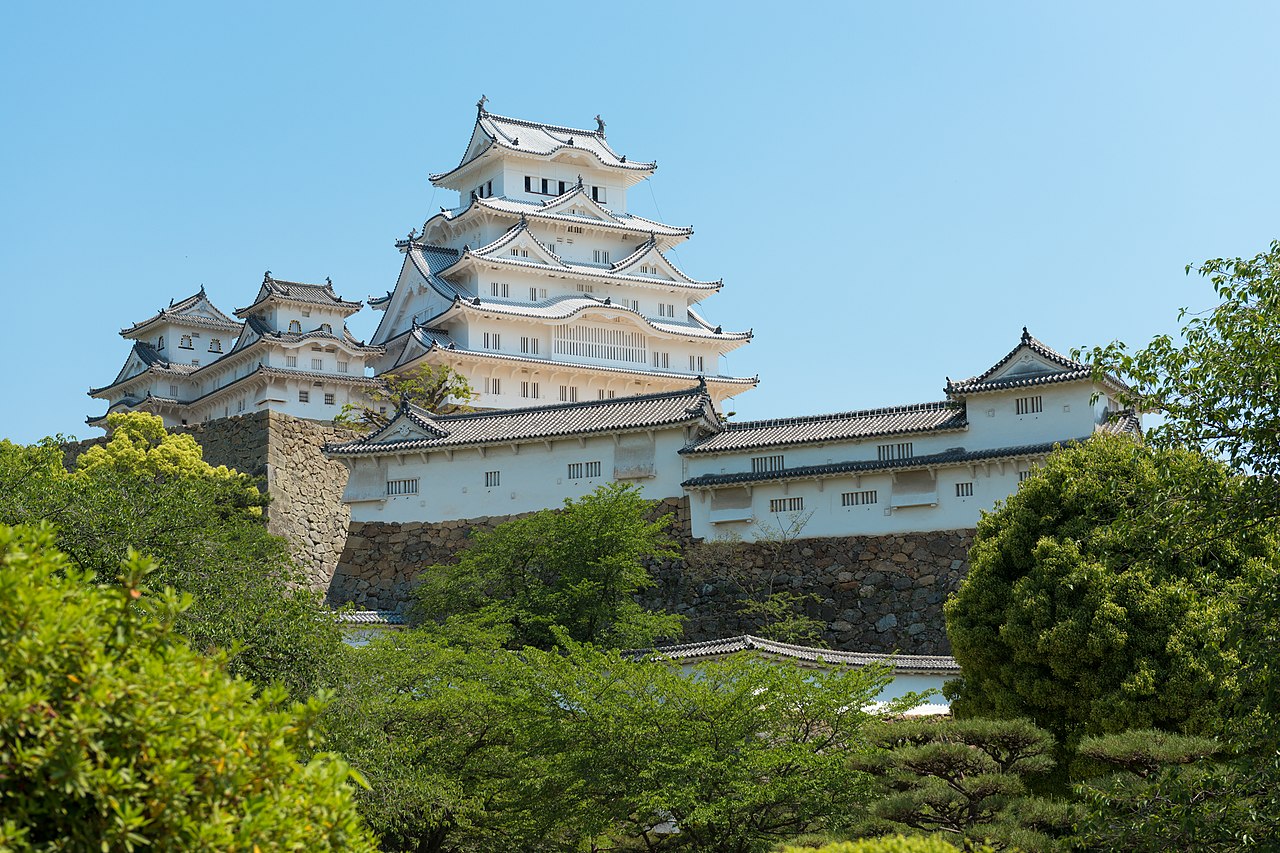
Japanese castle architecture — the multi-storey timber tenshu (keep) rising above stone-faced earthwork embankments (nagaya and yagura) within layered enclosures (maru) — developed rapidly in the latter half of the 16th century as a result of the military innovations of the Sengoku period, particularly the adoption of firearms. The tenshu was simultaneously a watchtower, a command post, and a political statement of daimyo (lord) power, not primarily a residence. By the early 17th century, the Tokugawa Shogunate began restricting castle construction. Most were subsequently demolished, damaged in the Meiji era, or destroyed in World War II. Only twelve original tenshu survive intact; the rest are modern reinforced-concrete reconstructions, however historically accurate their exteriors. Find all ten on the map.
1. Himeji-jo, Hyogo Prefecture
Himeji, the "White Heron Castle" (Hakuro-jo), is the finest surviving castle in Japan and one of the most recognisable buildings in Asia. The main tenshu complex — five connected towers on stone bases above the city of Himeji — was built by the Ikeda clan from 1601 on the site of earlier fortifications and completed around 1617. The white plaster walls were designed to resist fire from firearms and incendiary attack; the complex defensive passages through the inner enclosures, with their deceptive turns and concealed firing positions, represent the high point of Japanese military planning. UNESCO World Heritage Site since 1993. One of the twelve original surviving tenshu.
2. Matsumoto-jo, Nagano Prefecture
Matsumoto, the "Black Crow Castle" (Karasu-jo), is the oldest surviving tenshu in Japan, with the main keep and adjacent small tower dating from 1593- 94 under the Ogasawara and then Ishikawa clans, before the completion of Himeji. Its dramatic black lacquer exterior, reflected in the surrounding moat against the backdrop of the Japanese Alps, makes it among the most photographed castles in Japan. The castle is unusual in having a Tsukimi (moon- viewing) tower added in the 17th century — a purely ornamental addition in a period when military function was giving way to ceremonial display. One of the twelve original surviving tenshu.
3. Kumamoto-jo, Kumamoto Prefecture
Kumamoto, built by Kato Kiyomasa from 1601-07, was one of the most technically sophisticated castles in Japan: its curved stone base walls (musha-gaeshi) were designed to be unclimbable, leaning outward at their tops. The castle played a central military role in the Satsuma Rebellion of 1877, when imperial government forces held it against Saigo Takamori's forces for 50 days. The main tenshu (a 1960 reinforced-concrete reconstruction) was severely damaged in the 2016 Kumamoto earthquakes; restoration work is ongoing and the castle is partially open during the process.
4. Hikone-jo, Shiga Prefecture
Hikone Castle, on the shore of Lake Biwa in Shiga Prefecture, was built by Ii Naomasa and completed by his successors from 1603 to 1622 for the Ii clan, one of the most powerful under the Tokugawa Shogunate. The three-storey tenshu sits on a complex of stone embankments incorporating elements salvaged from earlier demolished castles — a common practice in the early Edo period when castle building restrictions increased the value of existing stone. One of the twelve original surviving tenshu and National Treasure designation in Japan.
5. Inuyama-jo, Aichi Prefecture
Inuyama, above the Kiso river in Aichi Prefecture, holds the oldest complete castle tower in Japan, with the lower two storeys dated to 1440 under the Oda clan and the upper storeys rebuilt around 1601. It was the only castle in Japan remaining in private ownership (by the Naruse family) from the Meiji era until 2004, when it was transferred to a foundation. The Kiso river below is still used for the traditional ukai (cormorant fishing) practised since the 8th century. One of the twelve original surviving tenshu.
6. Maruoka-jo, Fukui Prefecture
Maruoka, in Fukui Prefecture, holds the oldest surviving tenshu in the Hokuriku region, built by Shibata Katsutoyo in 1576 — though the current structure dates from reconstruction after an earthquake in the 17th century, and debate about its precise age continues among architectural historians. The stone roof tiles — unusually heavy for a tenshu and prone to slipping — are a diagnostic feature. One of the twelve original surviving tenshu.
7. Kochi-jo, Kochi Prefecture
Kochi Castle, on the Shikoku island in Kochi Prefecture, is the only surviving castle in Japan to have both its main keep and its ote-mon (main gate) intact from the Edo period, in their original relationship. Built by Yamanouchi Kazutoyo from 1601 and completed after a fire in 1753 in the current form, it is a compact castle on a rock outcrop above the city, with views that illustrate the strategic logic of its position. One of the twelve original surviving tenshu.
8. Matsue-jo, Shimane Prefecture
Matsue Castle, in the San'in region of Honshu above Lake Shinji, was completed in 1611 under Horio Yoshiharu and is the only surviving castle in the San'in region. It is notable as the setting for Lafcadio Hearn's 1894 essays on Japan, which introduced the West to Japanese domestic culture. The castle's five- storey main keep houses a well within the fortification — a provision against siege — and the original wooden interior including toilets and storage rooms survives. One of the twelve original surviving tenshu.
9. Bitchu Matsuyama-jo, Okayama Prefecture
Bitchu Matsuyama, at 430 metres elevation in the mountains of Okayama Prefecture, is the highest castle in Japan and the only original mountain castle tenshu to survive. Built by the Mizunoya clan in the 13th century and rebuilt in its current two-storey form around 1683, it is a small, austere structure entirely unlike the elaborate lowland castles. In autumn it is occasionally enveloped in cloud, creating the "castle in the sky" appearance that makes it one of the most photographed Japanese castle images. One of the twelve original surviving tenshu.
10. Osaka-jo, Osaka Prefecture
Osaka Castle, begun by Toyotomi Hideyoshi in 1583 and one of the largest castles in Japan by enclosure area, was the site of the decisive sieges of 1614-15 (Winter Campaign and Summer Campaign) in which Tokugawa Ieyasu eliminated the Toyotomi clan and consolidated Shogunate power. The current white tenshu is a 1931 reinforced-concrete reconstruction replacing the 19th-century tower that replaced the 17th-century original; the stone embankments of the inner compound are largely from the Tokugawa-era reconstruction of 1620-29. The museum inside is among the best castle interpretation programmes in Japan.
Original versus Reconstructed
The twelve original surviving tenshu are Himeji, Matsumoto, Inuyama, Hikone, Maruoka, Kochi, Matsue, Bitchu Matsuyama, Uwajima, Marugame, Matsuyama (Ehime), and Masuyama. Everything else is reconstruction, however accurate. The distinction matters for the experience: original tenshu have the specific weight and quality of old timber, the smell of centuries of use, the small imperfections that no reconstruction can replicate. Seek these first. Find them on the map.