Top 10 Castles in Romania
Romania's castle heritage is concentrated in Transylvania, the Carpathian region that was part of the Kingdom of Hungary from the 11th century to 1918 and was settled by Saxon (German) colonists from the 12th century who built a fortified landscape unique in Europe. The Transylvanian tradition encompasses both the great noble fortresses — built by the Hunyadi and other magnate families — and the hundreds of fortified churches in which Saxon communities defended themselves and their grain stores during Ottoman and Tartar raids. The 19th century added a layer of Romantic and royal castles. Find all ten on the map.
1. Peles Castle, Sinaia
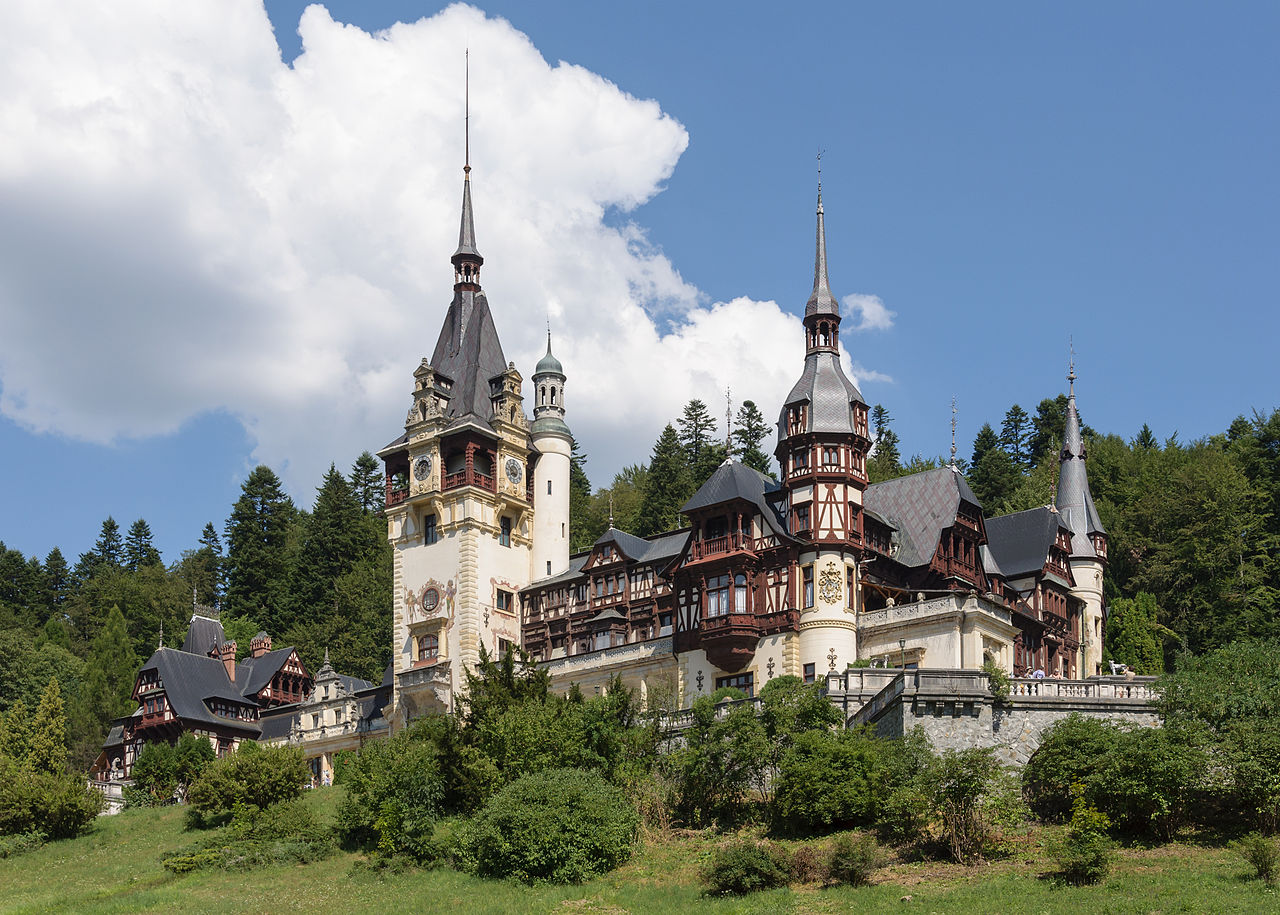
Peles, built in the German Neo-Renaissance style for King Carol I of Romania from 1873 in the Prahova valley below the Bucegi mountains, is the finest 19th- century castle in southeastern Europe. Carol I, a Hohenzollern prince invited to rule the new Romanian state, used Peles as a summer residence and political centre; it was here that Romania's entry into World War I was planned. The 160- room interior contains exceptional collections of armour, stained glass, and Flemish tapestries. The smaller Pelisor palace (1902) and the hydraulic- powered theatre curtain — the first electric installation in any castle in the world — are distinctive. The castle was nationalised in 1948 and is now a national museum.
2. Bran Castle, Brasov County
Bran, built by the Teutonic Knights from around 1212 and rebuilt in its current form by the city of Brasov from 1377, served as a customs post and garrison controlling the Bran Pass between Transylvania and Wallachia. Its connection to Vlad III of Wallachia (Vlad the Impaler, the historical figure loosely associated with Bram Stoker's Dracula) is minimal — Vlad may have been briefly held here in 1462 but there is no documented evidence of any significant stay. The castle was given to Queen Marie of Romania in 1920 as a gift from the citizens of Brasov and restored as a royal residence; it now belongs to the Habsburg-Lorraine heirs and operates as a museum.
3. Corvin Castle (Hunyadi), Hunedoara
Corvin Castle, above the Zlasti river in Hunedoara, is the finest Gothic castle in Romania and one of the finest in Eastern Europe. It was built by John Hunyadi — voivode of Transylvania and regent of Hungary, and the man who checked Ottoman expansion at the Battle of Belgrade in 1456 — from around 1440 on the site of an earlier fortification. The castle's multiple towers, the Knight's Hall, and the elaborate Bear's Gate are of exceptional quality. Matthias Corvinus, John's son who became King of Hungary in 1458, was reputedly imprisoned here before his father's release. The castle is one of the seven wonders of Romania.
4. Rasnov Citadel, Brasov County
Rasnov, a Saxon fortified citadel above the town of Rasnov in the Barsa valley, was built from the 14th century by the Saxon community as a refuge fortress — not a noble residence but a place the entire town population could retreat to during Ottoman or Tartar raids. Its walls enclose a small settlement including a church, houses, a school, and a remarkable well: the well was dug by Turkish prisoners of war over 17 years to provide water during siege, and its depth (approximately 146 metres) was rewarded by their freedom. The citadel was in use as a defensive refuge until the 17th century.
5. Fagaras Fortress, Brasov County
Fagaras, in the Fagaras Depression below the highest section of the Carpathians, was built in the 14th century by Vladislav I of Wallachia and substantially expanded in the 16th and 17th centuries by Transylvanian princes including Gabriel Bathory. Its moated quadrilateral plan with corner bastions is characteristic of the late Renaissance fortification style that replaced purely medieval approaches. Under communist rule it was used as a prison, and political prisoners including the Greek Catholic bishops arrested in 1948 were held here. It now houses the Fagaras Citadel Museum.
6. Sighisoara Citadel, Mures County (UNESCO)
Sighisoara (German: Schassburg) is a fortified Saxon town on a Transylvanian hill, founded in the 12th century by German colonists invited by the Hungarian Crown. The citadel on the hill, with nine of its original fourteen towers surviving, is the best-preserved inhabited medieval citadel in Europe and a UNESCO World Heritage Site since 1999. The Clock Tower (14th century), the Scholars' Stairway (a covered wooden staircase of 1642), and the Church on the Hill give the citadel its distinctive character. Vlad III of Wallachia was born in Sighisoara around 1431 — in the house on the main square that now operates as a restaurant.
7. Cantacuzino Castle, Prahova County
Cantacuzino Castle, in Busteni at the foot of the Bucegi mountains, was built for Prince Gheorghe Grigore Cantacuzino from 1911 and is the most ambitious Neo-Romanian architectural statement of the early 20th century. The Neo- Romanian style, developed from the 1880s, synthesised Wallachian and Moldavian Orthodox church architecture with Brancovan decorative vocabulary into a national architectural idiom. The castle is recently restored and operates as a hotel and cultural centre.
8. Iulia Hasdeu Castle, Prahova County
Iulia Hasdeu Castle at Campina, built by the philologist and historian Bogdan Petriceicu Hasdeu between 1893 and 1896 in memory of his daughter Iulia who died at 18, is the most personal castle in Romania. Hasdeu was deeply involved in spiritualism after his daughter's death, and the castle's design incorporates occult symbolism in its architecture and decoration. The small tower and the allegorical frescoes make it a curiosity of late-19th-century Romantic grief. It is now a national museum.
9. Banffy Castle, Cluj County
Banffy Castle in Bontida, begun by the Banffy family in the 16th century and expanded in Baroque form in the 18th century, was one of the finest aristocratic residences in Transylvania — called the "Versailles of Transylvania" by contemporaries. It was deliberately destroyed by retreating German forces in 1944, used as a stable in the communist period, and is now under restoration led by the Transylvania Trust with European funding. The ongoing restoration is one of the most ambitious heritage recovery projects in Romania.
10. Sturdza Castle, Iasi County
Sturdza Castle at Miclauseni in Moldavia, built for Prince Gheorghe Sturdza between 1880 and 1904 in a Gothic Revival style influenced by French Romanticism, is the most important castle in the Moldavian region of Romania. It fell into severe disrepair after nationalisation in 1948 and is now undergoing restoration by the Romanian Orthodox Church, which received it in restitution. The towers and chapel are the most complete surviving elements.
Fortified Saxon Churches: A Regional Note
Transylvania's most characteristic defensive heritage is not its noble castles but its network of over 150 fortified Saxon churches — the Kirchenburgen — in which village communities stored grain in defensive towers within the church enclosure and retreated during raids. Prejmer, Biertan, Viscri, and Saschiz are the best-known examples; all are UNESCO World Heritage Sites. They are on the map and are among the most rewarding rural heritage experiences in Eastern Europe.