Top 10 Castles in Italy
Italy's castle tradition does not fit any single narrative. The peninsula was contested between Lombards, Normans, Hohenstaufen emperors, the Papal States, and a dozen independent city-states, and each produced a distinctive military architecture. A Hohenstaufen hunting lodge in Apulia has nothing visually in common with a Sforza fortress in Milan or a Habsburg villa on the Adriatic. What unites them is the Roman infrastructure they all used, modified, or built over. Find them all on the map.
1. Castello di Miramare, Trieste
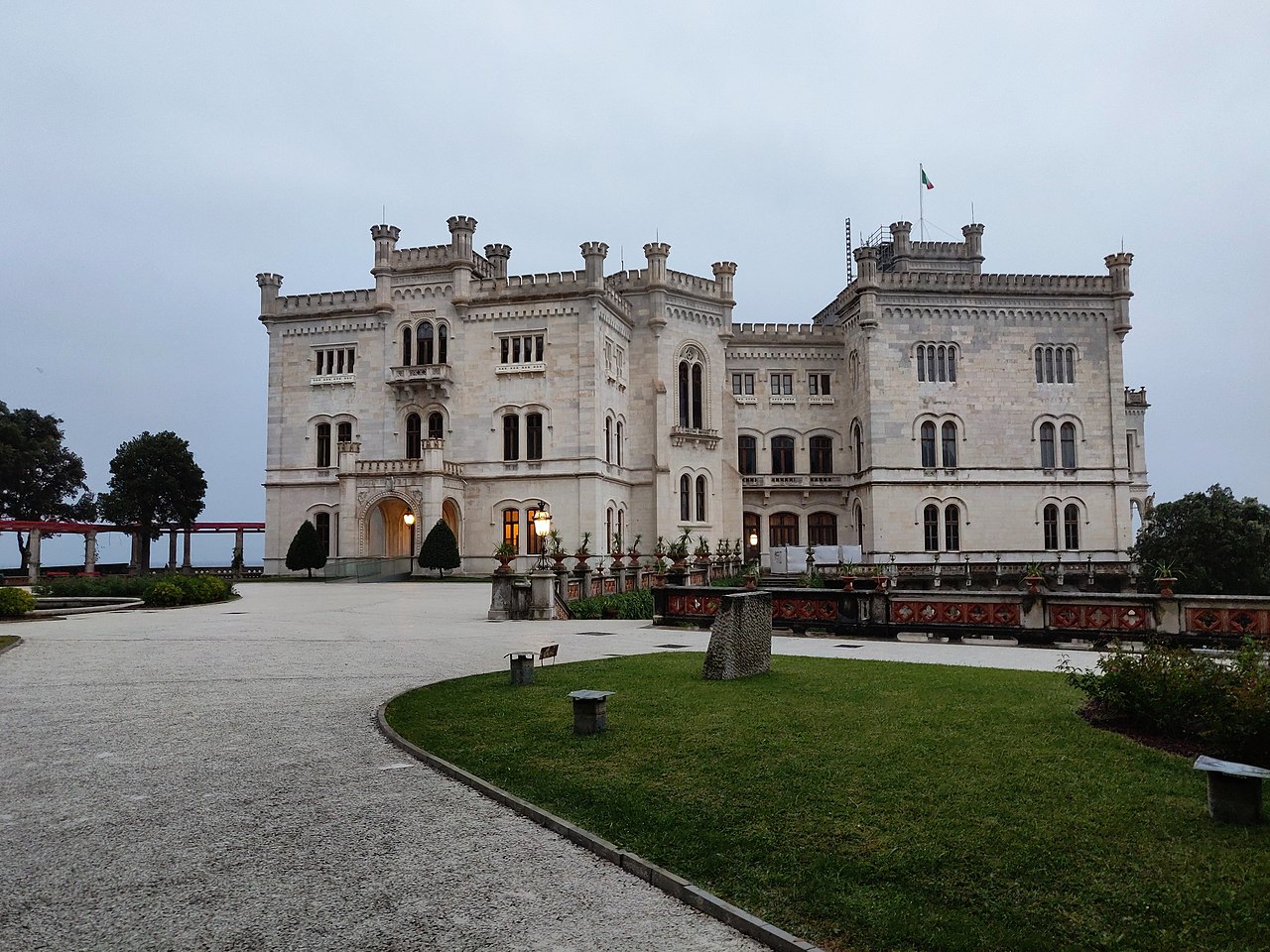
Miramare was built between 1856 and 1860 for Archduke Maximilian of Habsburg, the future Emperor Maximilian I of Mexico, on a sea-cliff promontory north of Trieste. The neo-Gothic design by the military engineer Carl Junker sits above the Adriatic and commands views of the Gulf of Trieste. Maximilian left for Mexico in 1864 and was executed by firing squad in 1867; the castle became property of the Italian state after World War I. A local legend holds that anyone who spends a night in the castle will come to a violent end — the evidence provided includes Maximilian, the Duke of Aosta, and others who stayed here, though the sample is selected.
2. Castel del Monte, Apulia (UNESCO)
Castel del Monte, built by Holy Roman Emperor Frederick II from approximately 1240 on a hill above the Apulian plateau, is the most geometrically precise castle in existence: a perfect regular octagon with eight octagonal towers at its corners. The plan has generated speculation about astrological, Templar, and numerological significance, though most architectural historians attribute its octagonal form to Frederick's knowledge of the Islamic architecture of Palermo and Jerusalem and his characteristic interest in geometric order. It was not a permanent residence but a hunting lodge and possibly an astronomical observation platform. UNESCO World Heritage Site since 1996.
3. Castello Sforzesco, Milan
The Sforzesco, a late-Gothic and Renaissance fortress in the centre of Milan, was built by Francesco Sforza from 1450 on the site of an earlier Visconti fortress. The round Filarete tower above the entrance, added in 1521, is the Milan skyline's most recognisable pre-modern element. Leonardo da Vinci worked for the Sforza court and his engineering notebooks contain proposals for improvements to the castle's fortifications and water systems. After Napoleon's entry into Milan in 1796, it was used as a barracks and partly demolished; its current appearance reflects late-19th-century restoration by Luca Beltrami. It now houses several of Milan's civic museums, including the Museo d'Arte Antica and its collection of Michelangelo's late work.
4. Castel Sant'Angelo, Rome (UNESCO)
Castel Sant'Angelo began as the mausoleum of Emperor Hadrian, completed 139 CE. The circular drum was converted to a fortress in the 5th century by the Visigoths' approach and has served continuously since: as a papal refuge connected to the Vatican by the Passetto di Borgo (still standing), as a prison (Giordano Bruno was held here), and as a military barracks. Popes fleeing invasion used the Passetto on multiple occasions, most famously Clement VII during the Sack of Rome in 1527 when Charles V's troops rampaged through the city. The angel on the summit commemorates a vision of Gregory I in 590.
5. Castello di Fenis, Aosta Valley
Fenis, in the Aosta Valley below the Monte Rosa massif, was built by the Challant family from the mid-13th century and expanded in the 14th and 15th centuries by Aimone de Challant. Its unusual combination of military architecture — concentric walls, towers, a deep moat — and elaborately painted interiors (the fresco cycle of around 1414 in the courtyard is among the finest secular Gothic painting in Italy) makes it exceptional. The Challants were allied with the Dukes of Savoy; Fenis was a seigneurial fortress rather than a royal garrison, and its furnishings reflect the cultivated tastes of a prosperous noble family at the height of Gothic courtly culture.
6. Castello di Verres, Aosta Valley
Verres, on a sheer rock above the Evanceon valley in the Aosta Valley, was built by Ibleto di Challant from 1390 with a deliberately simplified plan: a rectangular block with corner towers, prioritising structural strength over residential comfort. The contrast with Fenis — also a Challant castle, built slightly earlier in the same valley — illustrates the tension in late-medieval noble architecture between the demand for display and the reality of military utility. Verres is more fortress, Fenis more palace; both were necessary to the same family at the same moment.
7. Reggia di Caserta, Campania (UNESCO)
Caserta is a Bourbon palace, not a medieval castle, but its scale and the military logic of its construction earn it a place here. Begun in 1752 by Charles III of Spain for his Neapolitan kingdom on designs by Luigi Vanvitelli, it contains 1,200 rooms, 34 staircases, and a cascade garden over 3 kilometres long. It was built specifically to match Versailles as a statement of Bourbon power and to move the court from Naples to a site less vulnerable to naval bombardment. The Allies used it as headquarters during the Italian campaign of World War II. UNESCO World Heritage Site since 1997.
8. Castello Aragonese, Ischia
The Aragonese Castle on Ischia, a tuff rock connected to the island by a causeway since 1438 when Alfonso I of Aragon built the bridge, carries a continuous fortified history from the Syracusans (474 BCE) through the Byzantines, the Normans, and the Aragonese to the Bourbon Kingdom of the Two Sicilies. The existing castle was largely built by Alfonso and expanded through the 15th and 16th centuries. It held a population of 1,800 in the 17th century, including the convent of the Poor Clares, a cathedral, and farming terraces. Vittoria Colonna, the Renaissance poet and friend of Michelangelo, lived here from 1501 to 1536.
9. Castello Estense, Ferrara (UNESCO)
The Castello Estense at the centre of Ferrara was built from 1385 by Nicolo II d'Este after a revolt in the city. The Este family, Dukes of Ferrara, used it simultaneously as a fortress, prison, and court residence for two centuries, making it one of the best examples of the Italian medieval castle as urban political instrument. Parisina Malatesta and her stepson Ugo d'Este were executed in the castle's dungeons in 1425 on adultery charges, an event that became the basis of Byron's 1816 poem. The city of Ferrara is UNESCO-listed for its Renaissance urban planning, of which the Estense is the centrepiece.
10. Rocca Calascio, Abruzzo
Rocca Calascio, at 1,460 metres in the Gran Sasso massif of Abruzzo, is the highest castle in the Apennines and one of the most dramatic fortifications in Italy. Built as a watchtower in the 10th century and expanded to its current form in the 15th century, it was partially destroyed by an earthquake in 1703 and has remained a controlled ruin since. The view from the walls across the Navelli plain to the Gran Sasso peaks is unmatched in the region. It appeared as a film location in Ladyhawke (1985) and The Name of the Rose (1986).
Visiting Italian castles
Italy's heritage sites are managed by a fragmented combination of state, regional, and communal authorities, plus private owners. Opening hours vary dramatically; the Touring Club Italiano's castle guides are more reliable than online aggregators. The northeast (Aosta Valley, Trentino) has the densest concentration of medieval castles in a small area. The south (Apulia, Campania) holds the Norman and Hohenstaufen tradition. Every castle here is on the map.